

How to Specify an All-Steel Anti-static Floor for Data Centers?
Specifying an all-steel anti-static floor for a data center requires more than selecting a standard panel size. Load capacity, electrostatic discharge (ESD) performance, panel construction, fire resistance, and underfloor service space must all match the project requirements. At Huahong Activity Floor, we manufacture raised access flooring systems with concentrated load grades from 300 kg to 907 kg per panel, conductive and static-dissipative options, and adjustable pedestal structures for different data center layouts. This guide explains the technical points engineers and project managers should verify before finalizing a flooring specification.
Table of Contents
- 1. Determine the Required Load Capacity
- 2. Understand the All-Steel Panel Construction
- 3. Specify the Correct ESD Performance
- 4. Check Fire Performance and Applicable Standards
- 5. Plan the Underfloor Space and Support Structure
- 6. Select the Right Surface Finish
- 7. Prepare Technical Requirements Before Procurement
- 8. Frequently Asked Questions
1. Determine the Required Load Capacity Before Selecting Floor Panels
In our experience, load capacity is one of the first specifications that needs attention in a data center flooring project. A computer room may contain standard server cabinets, high-density racks, UPS equipment, battery cabinets, and other heavy electrical systems. Their loads are not distributed evenly across the floor. A fully equipped server rack can create a concentrated load at several small contact points, making panel strength more important than the average weight per square meter.
For a Computer Room All-steel Anti-static Floor, we offer six concentrated-load grades, ranging from 300 kg to 907 kg per 600 × 600 mm panel. This range allows the flooring specification to match different equipment configurations rather than relying on one standard load rating for the entire facility.
| Model | Panel Size (mm) | Concentrated Load (kg) | Ultimate Load (N) | Uniform Load (N/m²) |
|---|---|---|---|---|
| FS700 | 600 × 600 × 35 | ≥300 | ≥8,850 | ≥14,710 |
| FS800 | 600 × 600 × 35 | ≥363 | ≥11,250 | ≥17,780 |
| FS1000 | 600 × 600 × 35 | ≥454 | ≥14,500 | ≥22,220 |
| FS1250 | 600 × 600 × 35 | ≥567 | ≥18,360 | ≥27,780 |
| FS1500 | 600 × 600 × 35 | ≥680 | ≥22,170 | ≥33,340 |
| FS2000 | 600 × 600 × 35 | ≥907 | ≥29,420 | ≥44,450 |
For many conventional server room layouts, FS800 or FS1000 may be suitable starting points for technical evaluation. However, high-density server racks, heavy UPS units, and battery cabinets may require FS1250, FS1500, or FS2000. We recommend checking the fully loaded equipment weight, cabinet footprint, support points, and equipment layout before confirming the model.
One important detail: concentrated load, ultimate load, and uniform load describe different loading conditions. They should not be treated as interchangeable values. The final selection should also account for the pedestal spacing, stringer arrangement, and actual installation conditions.
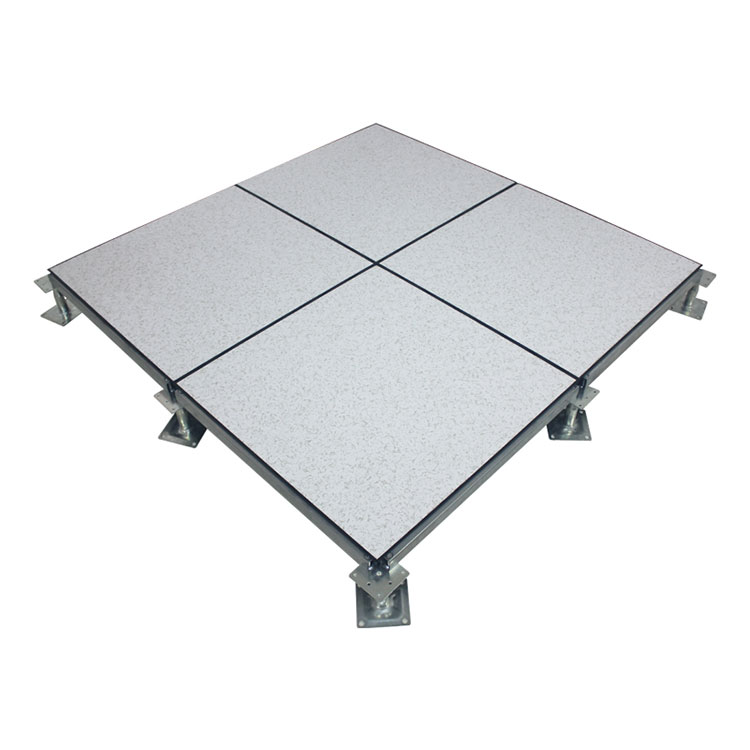
2. Understand the All-Steel Panel Construction
Panel construction directly affects the load-bearing performance and long-term stability of a raised access floor. Our all-steel panels use a cold-rolled steel shell, a deep-drawn lower plate, and a rigid upper plate. These components are spot-welded to form a closed cavity filled with pure cement.
This structure combines a steel exterior with a dense internal filling. The upper plate provides the working surface, while the lower formed plate contributes to the panel structure. The closed construction is designed to support concentrated equipment loads while maintaining panel rigidity during normal data center operation.
When evaluating an all-steel raised access floor, we suggest checking more than the material description. The panel thickness, welding quality, internal filling, edge finishing, and verified load-test results all matter. A steel panel specification without supporting load data is not enough to establish whether it is suitable for a particular server room.
For projects that require underfloor air distribution, our All Steel Anti-static Ventilation Floor provides an alternative with ventilation openings designed for airflow applications. This is worth considering during the initial layout stage rather than cutting openings into standard panels after installation.
3. Specify the Correct ESD Performance
Electrostatic discharge is a practical concern in computer rooms because sensitive electronic components can be affected by uncontrolled static electricity. An anti-static floor should therefore be specified according to its electrical resistance range and its connection to the building grounding system.
Our Computer Room All-steel Anti-static Floor is available in two electrical performance categories:
| Performance Category | Resistance Range | Typical Specification Purpose |
|---|---|---|
| Conductive | 10⁴–10⁶ Ω | Projects requiring a conductive flooring system |
| Static-Dissipative | 10⁶–10⁹ Ω | Projects requiring controlled static dissipation |
The electrical performance depends on the complete installed system, not just the steel panel itself. The surface finish, conductive adhesive layer, black conductive strips around the panel perimeter, pedestal connections, and grounding path all contribute to the final result.
For this reason, we recommend specifying the required resistance range at the beginning of the project. The electrical resistance should be verified through appropriate testing after installation, and the pedestal system should be properly bonded to the building grounding grid. Routine checks of panel surface resistance and grounding continuity are also useful for maintaining performance during long-term operation.
4. Check Fire Performance and Applicable Standards
Fire performance is another important consideration when selecting raised flooring for data centers. The floor system is installed above a service cavity containing cables and other infrastructure, so the material and its tested fire characteristics should be included in the technical review.
Our all-steel anti-static floor is tested to ASTM E84-01, with a flame spread index of 0 and smoke density of 0. The product is also manufactured and tested against GB/T 36340-2018 and SJ/T 10796-2017.
For international projects, we advise engineers and procurement teams to confirm the exact test method, report scope, and documentation required by the project specification. A reference to a standard should always be supported by the corresponding test documentation rather than treated as a general certification statement.
Huahong Activity Floor can provide batch-level test reports and coordinate third-party inspection when requested. This gives project teams a clearer basis for reviewing product compliance before shipment.
5. Plan the Underfloor Space and Support Structure
A raised floor is also a service platform. In a data center, the space below the panels may accommodate structured cabling, power busways, chilled-water piping, and other building services. The finished floor height should therefore be determined according to the actual routing requirements and maintenance access needed by the facility.
Our system consists of floor panels, galvanized stringers, and height-adjustable pedestals. The available finished floor height ranges from 90 mm to 1,200 mm, with an adjustment tolerance of ±20 mm.
| Component | Construction | Specification Consideration |
|---|---|---|
| Floor Panel | Cold-rolled steel shell with pure cement filling | Panel load grade and surface finish |
| Pedestal | Die-stamped steel top and base plates, hot-dip galvanized | Finished floor height and support loading |
| Stringer | Welded steel tube sections | Grid stability and lateral rigidity |
We recommend coordinating the raised floor layout with the MEP and data center engineering teams before production. This helps avoid conflicts between pedestal positions, cable routes, equipment foundations, and maintenance access points. A pedestal layout and loading plan can also make installation requirements clearer for the site contractor.
For projects where a more continuous finished surface is preferred, our Borderless All Steel Anti-Static Raised Floor is another configuration worth reviewing.
6. Select the Right Surface Finish for the Operating Environment
The surface finish should be selected according to the facility's cleaning requirements, expected foot traffic, and electrical performance specification. We offer high-pressure laminate (HPL, Abet series) and PVC finishes for our all-steel anti-static floor panels.
HPL and PVC are both used in raised access flooring, but the final selection should be based on the project specification and compatibility with the required ESD performance. The conductive adhesive layer and perimeter conductive strips also need to be considered as part of the complete system.
When reviewing samples, we suggest checking the surface appearance, edge finishing, panel dimensions, and resistance test results together. Looking at the decorative finish alone will not provide enough information to determine whether the complete flooring system meets the computer room requirements.
7. Prepare Technical Requirements Before Procurement
Before requesting a quotation for a Computer Room All-steel Anti-static Floor, we recommend preparing a project specification that includes the equipment loading information, floor height, ESD requirements, finish selection, and installation layout. These details help manufacturers calculate the required panel grades and supporting structure more accurately.
At Huahong Activity Floor, we integrate in-house R&D, precision manufacturing, custom processing, global sales, and professional on-site installation services. Established in March 2019 in Dongguan, Guangdong, we were awarded the title of National Science and Technology Enterprise of China in 2025, recognizing our independent innovation capabilities and technological development.
For data center flooring projects, our technical support at the RFQ stage can include:
- Load Selection: Evaluation of panel grades based on cabinet weight and equipment layout.
- Technical Drawings: Shop drawings, pedestal layout, and floor loading plans.
- Product Customization: OEM/ODM support for panel marking, HPL/PVC finishes, and edge details.
- Quality Documentation: Relevant product test reports and third-party inspection coordination upon request.
- Export Packaging: Heavy-duty palletized packing with corner protection and moisture barriers for sea transportation.
- Installation Support: Professional on-site installation services for projects requiring technical assistance.
For standard configurations, we typically provide project-specific quotations within 24 hours. Standard production lead time is generally 15–20 working days after sample approval and deposit receipt. Custom finishes and other project-specific requirements are confirmed after technical review and sample approval.
For a more accurate quotation, we suggest sending us the following information:
| Information Required | Purpose |
|---|---|
| Computer room floor area | Estimate panel quantities and layout |
| Maximum cabinet weight | Determine the required concentrated-load grade |
| Cabinet dimensions and layout | Evaluate load distribution and panel arrangement |
| Required finished floor height | Configure pedestal height and underfloor space |
| ESD resistance requirement | Select conductive or static-dissipative performance |
| Surface finish preference | Confirm HPL or PVC configuration |
| Project location and schedule | Plan delivery, packaging, and installation support |
Providing these details at the quotation stage helps us avoid unnecessary specification changes after production has started. It also gives the project team a clearer basis for comparing different raised floor configurations.
8. Frequently Asked Questions
Q1: What load capacity is suitable for a computer room all-steel anti-static floor?
The required grade depends on the fully loaded cabinet weight and its contact points with the floor. Our FS700 to FS2000 series covers concentrated loads from 300 kg to 907 kg per panel. FS800 and FS1000 may be starting points for many standard server room projects, while heavier cabinets and UPS equipment may require higher grades. The final selection should be verified against the equipment layout and support conditions.
Q2: What is the difference between conductive and static-dissipative raised flooring?
Conductive flooring has a resistance range of 10⁴–10⁶ Ω, while static-dissipative flooring has a range of 10⁶–10⁹ Ω in our product specifications. Both are designed for static control, but the appropriate category depends on the electrical requirements of the facility. The complete installed system should be tested to confirm its performance.
Q3: Can an all-steel anti-static floor accommodate underfloor cabling?
Yes. The adjustable pedestal and stringer system creates an accessible service cavity beneath the panels. Depending on the selected floor height, this space can accommodate structured cabling, power busways, and other building services. Our standard finished floor height range is 90–1,200 mm.
Q4: What surface finishes are available for computer room raised floors?
Our all-steel anti-static floor is available with HPL, including the Abet series, and PVC surface finishes. The selection should take into account the required ESD resistance, cleaning conditions, and project specifications. Conductive strips and the adhesive layer must also be compatible with the selected finish.
Q5: How long does it take to manufacture an all-steel anti-static raised floor?
For standard configurations, our typical production lead time is 15–20 working days after sample approval and deposit receipt. Custom finishes and special project requirements may need additional confirmation. We recommend providing the project quantity, technical specifications, and required delivery date when requesting a quotation.
Q6: What information should be included in a raised floor RFQ?
An RFQ should include the room dimensions, maximum equipment weight, cabinet layout, required load grade, finished floor height, ESD resistance range, surface finish, and project delivery schedule. Drawings and equipment specifications are particularly useful when selecting the pedestal arrangement and panel loading grade.
Choosing the right raised floor is ultimately a matter of matching the panel structure, load rating, electrical performance, and underfloor configuration to the actual operating conditions of the data center. At Huahong Activity Floor, we support this process through precision manufacturing, technical documentation, customized configurations, and installation services. Contact our team with your project drawings and equipment loading requirements to discuss a suitable all-steel anti-static raised floor solution.
```